
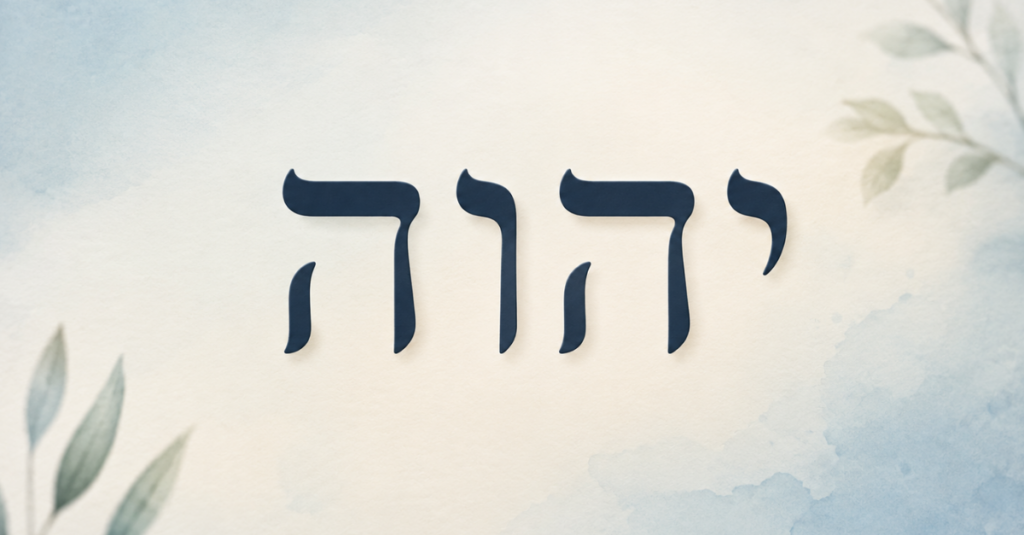
Growing up, if you asked me what the Creator’s name was, I would have confidently answered, “His name is God.” Or “His name is the Lord.” It wasn’t until later in my walk, when I began studying the Scriptures more deeply for myself, that I discovered the truth: God and Lord are not names at all. They are titles.
When we think of a President, Doctor, or a Teacher we know these are important titles, but they don’t tell us the actual name of the person who is holding that position. In the exact same way, the Creator of the universe holds supreme titles, but He also has a deeply personal, specific Name. And He wants us to know it.
The Hebrew Letters: יהוה
When we open up the original Hebrew manuscripts of the Old Testament, the Creator’s personal Name appears an incredible 6,800+ times. It was written using four Hebrew letters: יהוה.
In the academic world, these four letters are called the Tetragrammaton, which simply means four letters. In English, the Hebrew letters are written as YHVH.
So, what does this Name actually mean? When Moses asked the Creator for His Name at the burning bush, God replied, “I will be who I will be” (Exodus 3:14). The Name יהוה comes from the Hebrew verb meaning “to be” or “to exist.” His very Name means He Exists, The Self Existent One, or The One Who Causes to Be.
How to find the name?
God also said to Moses, “Say this to the people of Israel: ‘The LORD, the God of your fathers, the God of Abraham, the God of Isaac, and the God of Jacob, has sent me to you.’ This is my name forever, and thus I am to be remembered throughout all generations.
Exodus 3:15
The good news is that the translators left us a way to help identify where His name was! Once you know this how to find it, you can spot exactly where the Creator’s personal Name belongs in your own Bible.
Open your Bible and look closely at how the word “Lord” is spelled:
- The Personal Name (LORD): If you see the word spelled in ALL CAPITAL LETTERS (LORD or GOD), the original Hebrew text didn’t say “Lord” at all. It explicitly used His sacred, personal Name: יהוה.
Go look at Exodus 3:15 in a standard Bible. It likely reads: “This is My name forever, and this is My memorial to all generations.” But look closer at that verse, the word “LORD” is in all caps. The Creator is explicitly saying that יהוה is His Name forever.
Why was the Name Hidden?
Centuries ago, a tradition developed out of a fear of accidentally misusing or disrespecting the holy Name of God. To prevent this, people stopped pronouncing the Name out loud. When reading Scripture, every time they came across the letters יהוה, they would verbally substitute it with the Hebrew word Adonai, which means “Lord.”
When scholars eventually translated the Hebrew Scriptures into English, they decided to carry this tradition over into our modern Bibles we have today. Instead of printing His actual Name, they substituted it with the word “LORD.”
However, because the tradition developed to stop pronouncing the name of God out loud, the original vowel sounds were eventually lost to history over the centuries. Because the text only preserves the four consonants יהוה (YHVH), no one alive today knows with absolute, one hundred percent certainty exactly how it was pronounced in ancient times.
I personally choose to call Him Yehovah, as I believe it is the closest linguistic pronunciation to His revealed Name.
Knowing Him Beyond a Title
Learning His Name changed everything for me. It transformed my prayers from speaking to a distant concept into speaking to a real, specific Living God. Titles keep us at arm’s length, but names invite intimacy. The Creator didn’t hide His Name from us; He printed it thousands of times across the Bible so that we could call upon Him personally.
What’s Next?
Now that we know who He is and we know His personal Name, what is He actually like? What is His personality? In the next post, we are going to look how Yehovah defines His own character, His likes, His dislikes, and His unchanging heart.
Next Post: The Heart of the Father