
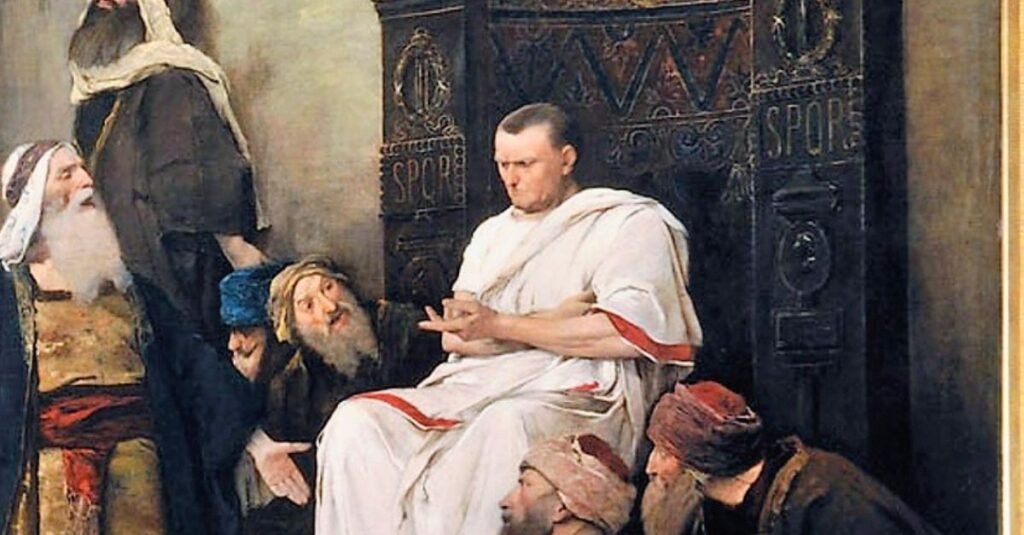
Pontius Pilate is one of the most well known figures in the Gospel accounts, yet many of us know very little about the Roman governor who sentenced Yeshua to death, including myself. So I decided to look into who he really was. Here’s a closer look at what I found about who he was, what he did, and what historical sources tell us.
Pontius Pilate was born in the 1st century BC and died sometime after 39 AD. He served as the Roman ruler over Judea from 26–36 AD, making him the fifth governor under Emperor Tiberius. The Jewish Roman historian Josephus wrote in Antiquities of the Jews that Pilate governed Judea for ten years.
Pilate is most famously remembered for approving the death of Yeshua, the Jewish Messiah, by crucifixion. He also caused an uproar among the Jews and Samaritans, particularly when he tried to enforce Roman religious practices and the worship of the emperor. As prefect of Judea, he gained a reputation for harsh and oppressive rule.
Pilate’s Rule and Reputation
As the Roman governor of Judea, Pilate managed taxes, coin production, and capital punishment, including crucifixion. He also oversaw civil and religious matters with the Jewish Sanhedrin, appointed the High Priest, and kept the priestly garments at the Antonia Fortress.
Ancient writers such as Josephus and Philo of Alexandria, a Greek Jewish philosopher, described Pilate as a cruel and harsh leader. Interestingly, Pilate was later honored in some Eastern churches, while Western traditions generally condemn him for his role in Yeshua’s death.
Claudia Procula: His Wife
Pilate’s wife, Claudia Procula, is mentioned in the Gospel of Matthew (27:19). She sent a message to Pilate warning him about Yeshua after having a troubling dream, urging him to do what was right.
This brief mention suggests she recognized something about Yeshua and tried to influence Pilate’s decision, showing a personal and moral side during the political pressure of the trial.
Both historical and scholarly sources suggest Claudia may have come from a prominent Roman family, possibly connected to a former consul, which could explain her influence and presence in Pilate’s household.
She is sometimes honored as a saint in Eastern traditions, while Western traditions generally do not. Some apocryphal writings expand her story, showing her as a compassionate woman who foresaw the injustice Yeshua would face.
Her story gives us a glimpse into the household of a Roman governor during one of the most tense times in Judean history.
Conflicts with the Jewish People
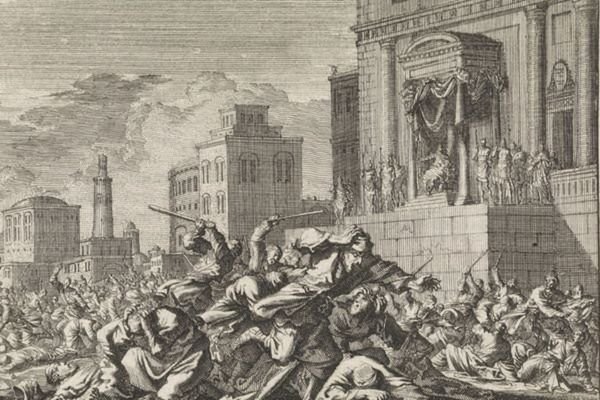
Pilate’s rule was marked by repeated clashes with the Jewish people. Soon after taking office, he brought Roman military standards bearing the emperor’s image into Jerusalem.
The Jewish and Samaritan people saw this as deeply offensive, and protests went on for five days at his residence in Caesarea. Pilate finally removed the images when his soldiers couldn’t break up the crowd.
Later, Pilate placed golden shields with the emperor’s name on a building in Herod’s palace. Complaints reached Emperor Tiberius, and Pilate was forced to take them down. He also used money from the Temple treasury to build a new aqueduct in Jerusalem.
While the project improved the city’s infrastructure, using sacred money sparked riots. Soldiers attacked protesters, causing casualties. These events added to his reputation as a harsh ruler.
The Trial of Yeshua
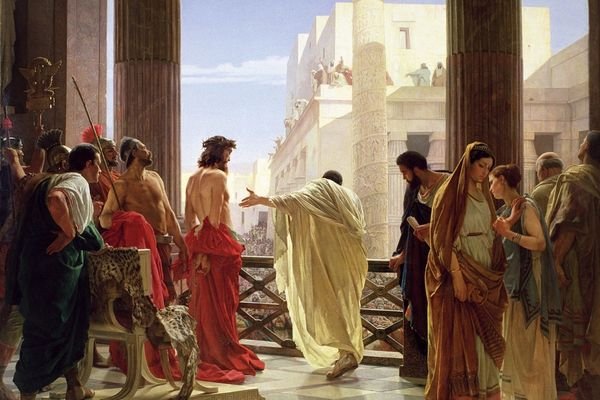
As the Passover approached, tensions in Jerusalem were high. Pilate, the Roman governor, found himself at the center of a difficult situation.
Yeshua was brought before Pilate by the Jewish leaders, who accused Him of claiming to be the King of the Jews, a charge that could be seen as challenging Roman authority.
They hoped Pilate would approve a sentence of death. Pilate, however, was unsure whether Yeshua had actually done anything worthy of execution.
But the crowd demanded that He be crucified. Following the Passover custom, Pilate offered to release one prisoner, and the crowd chose Barabbas, a man imprisoned for rebellion and murder.
Even though he felt Yeshua was innocent, Pilate let the crowd decide, showing both how careful he was politically and how much pressure he faced from the local leaders.
Before handing Yeshua over for crucifixion, Pilate washed his hands publicly, symbolizing that he claimed no personal responsibility. He then ordered the execution and affixed a sign above the cross reading “Yeshua of Nazareth, King of the Jews” in Hebrew, Latin, and Greek.
This sign angered the Jewish leaders, but Pilate refused to remove or alter it. His actions reveal the delicate balance he tried to maintain between fearful of upsetting Rome while facing local unrest and role in the trial and crucifixion of Yeshua.
Archaeological Evidence
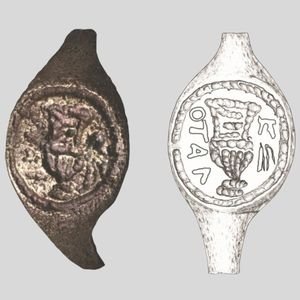
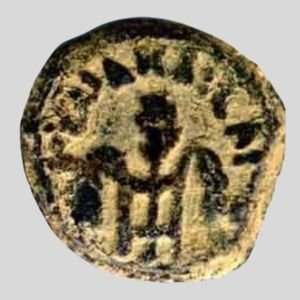
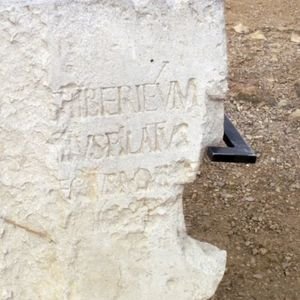
Click here for Image Credits
Roman ring inscribed with pilate’s name — The Herodium Expedition, The Institute of Archaeology, The Hebrew University of Jerusalem; drawing: J. Rodman; photo: C. Amit, IAA Photographic Department
Coins minted — During Pilate’s rule as governor, Source
Pilate Stone — 1961 inscription naming Pilate, Caesarea Maritima, Source
Physical evidence shows that Pontius Pilate really was a Roman governor of Judea. One of the most famous finds is the Pilate Stone, discovered in 1961 at Caesarea Maritima. This limestone block has an inscription with his name and title, directly linking him to Roman rule in the region.
Coins minted under Tiberius during Pilate’s time as governor have also been found, giving more evidence of his rule. A Roman ring with Pilate’s name has also been discovered, offering another real connection to the governor and his historical existence.
These artifacts back up what ancient historians wrote. Josephus and Philo describe Pilate’s clashes with the Jewish and Samaritan populations, and Tacitus mentions him by name in connection with Yeshua’s execution under Tiberius.
Together, these sources and archaeological finds show that Pilate wasn’t a made up figure, but a real Roman official whose actions left a lasting mark on history.
Legacy
Some people see Pilate as cruel, others think he was weak, and some even consider him a saint. Most agree he wasn’t a mastermind, he was just a man who didn’t understand the people he ruled and was afraid of upsetting Rome.
Even today, opinions are divided: some view him favorably, while others still despise him. In the end, Pilate was a man who played a key role in ordering the death of Yeshua the Messiah, causing unrest and sparking riots among the Jews and Samaritans during his rule.
After his time as governor, Pilate went to Rome to answer to the emperor, who had already died before he arrived. According to Eusebius of Caesarea, a historian of Christianity, Pilate may have been exiled and eventually committed suicide under Emperor Caligula, though some accounts say he simply disappeared, leaving his final fate unknown.
Looking at Pontius Pilate gives us important context for the Gospel stories. His decisions, the political pressures he faced, and his clashes with the Jewish people help show the tensions around Yeshua’s trial and crucifixion. Understanding Pilate’s role lets us see how these events really unfolded within their historical and political setting.
Source and Citations
Historical Sources
- Flavius Josephus — Antiquities of the Jews & Jewish War, Book XVIII / Sefaria Edition / Gutenberg Edition
- Philo of Alexandria — Embassy to Gaius / EarlyChristianWritings (Yonge Translation) / Internet Archive — Philo Complete Works (Unabridged)
- Tacitus — Annals, Book 15, Chapter 44 Penelope Chicago edition, “Christus, the founder of the name, had undergone the death penalty in the reign of Tiberius, by sentence of the procurator Pontius Pilatus.”
Archaeological Evidence
- Pilate Stone — 1961 inscription naming Pilate, Caesarea Maritima, Source
- Coins minted — During Pilate’s tenure as governor, Source
Church History / Later Traditions
- Eusebius of Caesarea — Ecclesiastical History, HE 2.7 / Pilate exiled, possibly committed suicide under Caligula, Catholic Encyclopedia
- Pilate’s wife — Venerated in traditions from non biblical and apocryphal writings, OrthoChristian
Bible References
- Gospels, Bible Gateway — Matthew 27 / Mark 15 / Luke 23 / John 19
General Reference / Background
- Pontius Pilate — Wikipedia / Britannica / Catholic Encyclopedia